SQL Window Functions
The analytical superpower every data professional needs to master
SQL Window Functions: Key Concepts
The analytical superpower every data professional needs to master
Imagine trying to understand your company's sales trends, but every query forces you to choose between seeing the big picture or the individual details--you either lose the nuance or drown in raw data. Data professionals need a way to combine detailed records with high-level insights in a single query, without sacrificing clarity or performance. SQL window functions provide that solution, allowing you to perform advanced calculations across related rows while keeping every record intact--delivering rankings, running totals, comparisons, and more with simple, elegant syntax. As you'll see in this guide, window functions replace complex joins and subqueries, speed up analysis, and unlock capabilities that were once impractical in pure SQL, making them an essential skill for anyone serious about data.
What Makes Window Functions Special?
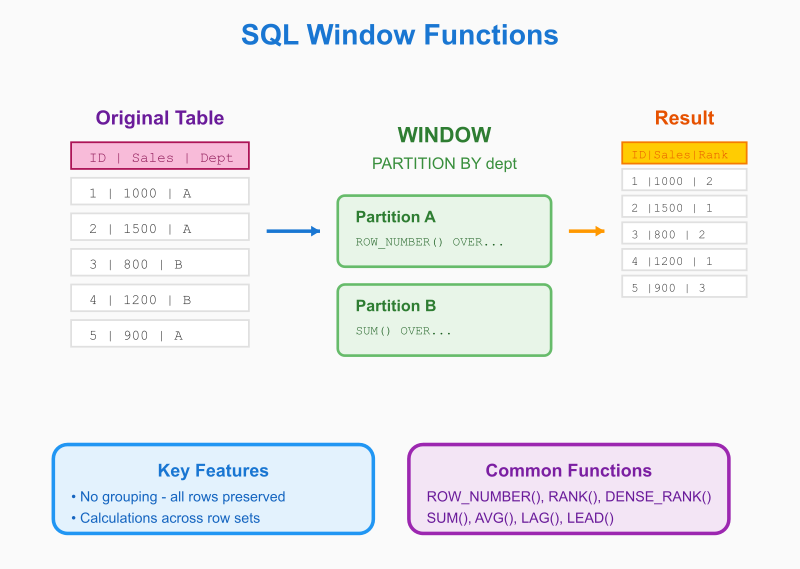
Think of window functions as "smart aggregations" that can look at related data without losing granularity. They create a "window" of context around each row, performing calculations across related records while keeping all original data intact.
The Traditional Problem:
-- You lose all individual sale details
SELECT salesperson, SUM(amount)
FROM sales GROUP BY salesperson;

-- You see details but no context
SELECT * FROM sales;
The Window Function Solution:
-- You get BOTH: individual details AND contextual insights
SELECT
    salesperson, product, amount,
    SUM(amount) OVER (PARTITION BY salesperson) as total_sales,
    RANK() OVER (ORDER BY amount DESC) as company_rank
FROM sales;
Core Syntax Pattern
Every window function follows this elegant pattern:
FUNCTION() OVER (window_specification)The OVER clause defines three key aspects:
- PARTITION BY - Creates groups (like GROUP BY, but keeps all rows)
- ORDER BY - Sorts within each partition
- Frame clause - Defines exactly which rows to include in calculations
Essential Function Categories
1. Aggregate Functions - SUM, AVG, COUNT, MIN, MAX
Transform regular aggregates into powerful analytical tools:
- Running totals that grow with each row
- Moving averages across time windows
- Group totals without losing individual records
2. Ranking Functions - ROW_NUMBER, RANK, DENSE_RANK
Assign positions and handle ties intelligently:
- Unique sequential numbering
- Olympic-style ranking (ties get same rank, gaps after)
- Dense ranking (no gaps after ties)
3. Value Functions - LAG, LEAD, FIRST_VALUE, LAST_VALUE
Access data from other rows in your window:
- Compare current vs previous periods
- Find first/last values in sequences
- Calculate period-over-period changes
4. Distribution Functions - NTILE, PERCENT_RANK, CUME_DIST
Understand data distribution and percentiles:
- Divide data into equal buckets
- Calculate percentile rankings
- Determine cumulative distributions
Frame Specifications: The Secret to Precision
Frames define exactly which rows participate in your calculation. This is where window functions become incredibly powerful:
-- Different frames, different results:
SUM(sales) OVER (ORDER BY date ROWS UNBOUNDED PRECEDING)        -- Running total
SUM(sales) OVER (ORDER BY date ROWS BETWEEN 2 PRECEDING AND CURRENT ROW)  -- 3-day total
SUM(sales) OVER (ORDER BY date RANGE BETWEEN INTERVAL '1 MONTH' PRECEDING AND CURRENT ROW)  -- Monthly total
ROWS vs RANGE:
- ROWS counts physical row positions
- RANGE works with logical value ranges (especially powerful with dates)
Why Window Functions Are Game-Changers
1. Analytical Simplicity
Replace complex self-joins and subqueries with elegant single queries:
-- Instead of complex subqueries for ranking
SELECT *,
    RANK() OVER (PARTITION BY department ORDER BY salary DESC) as dept_rank
FROM employees;
2. Performance Excellence
Modern databases optimize window functions heavily. They're often faster than equivalent subquery approaches and enable operations impossible with traditional SQL.
3. Business Intelligence Power
Solve real-world analytical challenges:
- Customer Analytics: Lifetime value, purchase sequences, cohort analysis
- Sales Intelligence: Running totals, territory rankings, quota tracking
- Financial Reporting: Period comparisons, moving averages, trend analysis
- Time Series Analysis: Seasonality detection, anomaly identification, forecasting
4. Universal Compatibility
Supported across all major databases (MySQL, PostgreSQL, SQL Server, Oracle, SQLite) with consistent syntax.
Common Use Cases That Will Transform Your Analysis
Running Calculations
-- Revenue trends with context
SELECT date, revenue,
    SUM(revenue) OVER (ORDER BY date) as cumulative_revenue,
    AVG(revenue) OVER (ORDER BY date ROWS 6 PRECEDING) as weekly_avg
FROM daily_sales;
Top-N Analysis
-- Best performers in each region
SELECT * FROM (
    SELECT employee, region, sales,
        RANK() OVER (PARTITION BY region ORDER BY sales DESC) as rank
    FROM sales_data
) WHERE rank <= 3;
Period Comparisons
-- Month-over-month growth
SELECT month, revenue,
    LAG(revenue) OVER (ORDER BY month) as prev_month,
    (revenue - LAG(revenue) OVER (ORDER BY month)) /
    LAG(revenue) OVER (ORDER BY month) * 100 as growth_rate
FROM monthly_revenue;
Customer Journey Analysis
-- Track customer order sequences
SELECT customer_id, order_date, amount,
    ROW_NUMBER() OVER (PARTITION BY customer_id ORDER BY order_date) as order_number,
    SUM(amount) OVER (PARTITION BY customer_id ORDER BY order_date) as lifetime_value
FROM orders;
The Learning Path
Window functions follow a natural progression:
Beginner Level:
- Master basic syntax and common functions
- Understand PARTITION BY and ORDER BY
- Practice with simple ranking and running totals
Intermediate Level:
- Complex frame specifications
- Advanced analytical patterns (cohorts, funnels)
- Performance optimization techniques
Advanced Level:
- Statistical analysis and anomaly detection
- Custom algorithms and sophisticated business logic
- Enterprise-scale optimization strategies
Why Start Now?
Window functions represent a paradigm shift in SQL analytics. They transform SQL from a simple data retrieval language into a powerful analytical programming environment. Whether you're doing ad-hoc analysis, building reports, or creating data pipelines, window functions will:
- Simplify complex queries by replacing joins and subqueries
- Improve performance through database optimizations
- Enable new analytical capabilities previously requiring external tools
- Make your SQL more readable and maintainable
Ready to Transform Your SQL?
Window functions might seem complex initially, but they follow logical patterns. Once you grasp the core concepts, you'll wonder how you ever analyzed data without them. They're not just another SQL feature - they're the foundation of modern data analysis.
The journey from basic aggregations to sophisticated analytics starts with understanding these key concepts. From here, you can build toward solving real business problems with elegant, powerful SQL that would have been impossible before window functions existed.
Interested in more Examples of SQL Window Functions?
Enjoyed this article? Share it with someone who'd love it too.