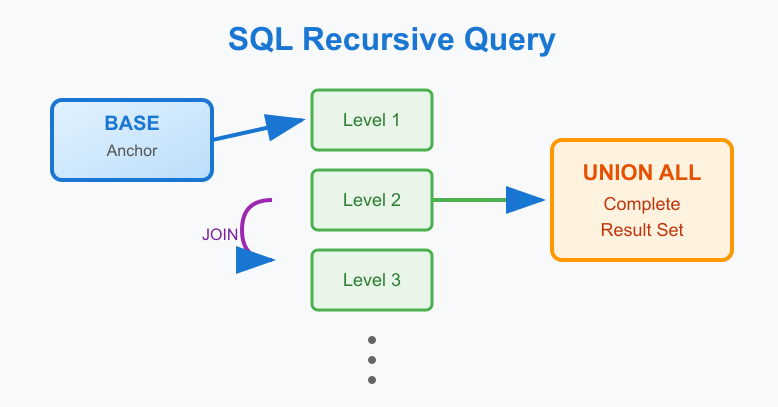
Recursive Queries in SQL
Using recursive CTEs to traverse hierarchies, trees, and graphs in a single query
Recursive Queries - Advanced Examples
Example 1: Social Network Analysis
Social networks involve complex many-to-many relationships. Let's explore advanced patterns for analyzing connections and influence.
Schema Setup
CREATE TABLE users
(
    user_id BIGINT PRIMARY KEY,
    username VARCHAR(50) NOT NULL,
    email VARCHAR(255) NOT NULL,
    first_name VARCHAR(100) NOT NULL,
    last_name VARCHAR(100) NOT NULL,
    created_at TIMESTAMP NOT NULL DEFAULT CURRENT_TIMESTAMP,
    is_active BOOLEAN NOT NULL DEFAULT TRUE,

    UNIQUE KEY uk_users_username (username),
    UNIQUE KEY uk_users_email (email),
    INDEX idx_users_active (is_active)
) COMMENT = 'User profiles in the social network';

CREATE TABLE connections
(
    connection_id BIGINT PRIMARY KEY,
    follower_user_id BIGINT NOT NULL,
    following_user_id BIGINT NOT NULL,
    connection_type ENUM('follow', 'friend', 'block') NOT NULL DEFAULT 'follow',
    created_at TIMESTAMP NOT NULL DEFAULT CURRENT_TIMESTAMP,
    is_active BOOLEAN NOT NULL DEFAULT TRUE,

    -- Critical indexes for recursive traversal
    INDEX idx_connections_follower_active (follower_user_id, is_active),
    INDEX idx_connections_following_active (following_user_id, is_active),
    INDEX idx_connections_type_active (connection_type, is_active),

    UNIQUE KEY uk_connections_pair (follower_user_id, following_user_id),
    FOREIGN KEY (follower_user_id) REFERENCES users(user_id),
    FOREIGN KEY (following_user_id) REFERENCES users(user_id)
) COMMENT = 'Connections between users (follows, friendships, etc.)';
Advanced Query: Find Influence Network
This query finds all users within N degrees of separation and calculates influence metrics:
WITH RECURSIVE influence_network AS
(
    -- Anchor: Start with target user
    SELECT
        u.user_id
        , u.username
        , u.first_name
        , u.last_name
        , 0 AS degrees_of_separation
        , 1.0 AS influence_weight
        , ARRAY[u.user_id] AS path_users
        , CAST(u.username AS VARCHAR(1000)) AS influence_path
    FROM users u
    WHERE
        u.user_id = 12345  -- Starting user
        AND u.is_active = TRUE

    UNION ALL

    -- Recursive step: Follow connections outward
    SELECT
        u.user_id
        , u.username
        , u.first_name
        , u.last_name
        , inet.degrees_of_separation + 1
        , inet.influence_weight * 0.7 AS influence_weight  -- Decay influence by distance
        , inet.path_users || u.user_id AS path_users
        , CONCAT(inet.influence_path, ' -> ', u.username) AS influence_path
    FROM influence_network inet
    INNER JOIN connections c ON inet.user_id = c.follower_user_id
    INNER JOIN users u ON c.following_user_id = u.user_id
    WHERE
        inet.degrees_of_separation < 3  -- Limit to 3 degrees of separation
        AND c.connection_type = 'follow'
        AND c.is_active = TRUE
        AND u.is_active = TRUE
        AND NOT (u.user_id = ANY(inet.path_users))  -- Prevent cycles
)
SELECT
    user_id
    , username
    , first_name
    , last_name
    , degrees_of_separation
    , ROUND(influence_weight, 3) AS influence_score
    , influence_path
FROM influence_network
WHERE degrees_of_separation > 0  -- Exclude the starting user
ORDER BY degrees_of_separation, influence_weight DESC
LIMIT 100;
Advanced Query: Find Mutual Connections
This finds shared connections between two users at various depths:
WITH RECURSIVE user_network AS
(
    -- Build network from first user
    SELECT
        c.following_user_id AS connected_user_id
        , 1 AS depth_from_user1
        , 'user1' AS source_user
    FROM connections c
    INNER JOIN users u ON c.following_user_id = u.user_id
    WHERE
        c.follower_user_id = 12345  -- User 1
        AND c.connection_type = 'follow'
        AND c.is_active = TRUE
        AND u.is_active = TRUE

    UNION ALL

    -- Extend network from first user (recursive)
    SELECT
        c.following_user_id
        , un.depth_from_user1 + 1
        , 'user1'
    FROM user_network un
    INNER JOIN connections c ON un.connected_user_id = c.follower_user_id
    INNER JOIN users u ON c.following_user_id = u.user_id
    WHERE
        un.depth_from_user1 < 2
        AND un.source_user = 'user1'
        AND c.connection_type = 'follow'
        AND c.is_active = TRUE
        AND u.is_active = TRUE
)
, user2_network AS
(
    -- Build network from second user
    SELECT
        c.following_user_id AS connected_user_id
        , 1 AS depth_from_user2
    FROM connections c
    INNER JOIN users u ON c.following_user_id = u.user_id
    WHERE
        c.follower_user_id = 67890  -- User 2
        AND c.connection_type = 'follow'
        AND c.is_active = TRUE
        AND u.is_active = TRUE

    UNION ALL

    -- Extend network from second user (recursive)
    SELECT
        c.following_user_id
        , un2.depth_from_user2 + 1
    FROM user2_network un2
    INNER JOIN connections c ON un2.connected_user_id = c.follower_user_id
    INNER JOIN users u ON c.following_user_id = u.user_id
    WHERE
        un2.depth_from_user2 < 2
        AND c.connection_type = 'follow'
        AND c.is_active = TRUE
        AND u.is_active = TRUE
)
SELECT
    u.user_id
    , u.username
    , u.first_name
    , u.last_name
    , un1.depth_from_user1
    , un2.depth_from_user2
    , (un1.depth_from_user1 + un2.depth_from_user2) AS total_distance
FROM user_network un1
INNER JOIN user2_network un2 ON un1.connected_user_id = un2.connected_user_id
INNER JOIN users u ON un1.connected_user_id = u.user_id
WHERE un1.source_user = 'user1'
ORDER BY total_distance, u.username
LIMIT 50;
Example 2: Advanced Bill of Materials with Cost Rollup
Manufacturing systems require complex recursive calculations for cost analysis and inventory planning.
Schema Setup
CREATE TABLE products
(
    product_id BIGINT PRIMARY KEY,
    product_code VARCHAR(50) NOT NULL,
    name VARCHAR(255) NOT NULL,
    description TEXT,
    unit_cost DECIMAL(12,4) NOT NULL DEFAULT 0.0000,
    labor_cost DECIMAL(12,4) NOT NULL DEFAULT 0.0000,
    is_manufactured BOOLEAN NOT NULL DEFAULT FALSE,
    is_active BOOLEAN NOT NULL DEFAULT TRUE,
    created_at TIMESTAMP NOT NULL DEFAULT CURRENT_TIMESTAMP,
    updated_at TIMESTAMP NOT NULL DEFAULT CURRENT_TIMESTAMP ON UPDATE CURRENT_TIMESTAMP,

    UNIQUE KEY uk_products_code (product_code),
    INDEX idx_products_manufactured_active (is_manufactured, is_active)
) COMMENT = 'Master product catalog including raw materials and assemblies';

CREATE TABLE bill_of_materials
(
    bom_id BIGINT PRIMARY KEY,
    parent_product_id BIGINT NOT NULL,
    component_product_id BIGINT NOT NULL,
    quantity_required DECIMAL(10,4) NOT NULL,
    waste_factor DECIMAL(5,4) NOT NULL DEFAULT 1.0000,
    is_active BOOLEAN NOT NULL DEFAULT TRUE,
    effective_date DATE NOT NULL,
    end_date DATE NULL,
    created_at TIMESTAMP NOT NULL DEFAULT CURRENT_TIMESTAMP,

    -- Essential indexes for recursive BOM traversal
    INDEX idx_bom_parent_active (parent_product_id, is_active),
    INDEX idx_bom_component_active (component_product_id, is_active),
    INDEX idx_bom_dates (effective_date, end_date),

    FOREIGN KEY (parent_product_id) REFERENCES products(product_id),
    FOREIGN KEY (component_product_id) REFERENCES products(product_id)
) COMMENT = 'Bill of materials defining product composition and quantities';
Advanced Query: Complete Cost Rollup with Manufacturing Overhead
This query calculates total cost including all sub-components and manufacturing overhead:
WITH RECURSIVE bom_explosion AS
(
    -- Anchor: Start with target product
    SELECT
        p.product_id
        , p.product_code
        , p.name
        , p.unit_cost
        , p.labor_cost
        , p.is_manufactured
        , 1.0 AS quantity_needed
        , 0 AS level_depth
        , p.unit_cost AS raw_material_cost
        , p.labor_cost AS direct_labor_cost
        , CAST(p.product_code AS VARCHAR(1000)) AS component_path
    FROM products p
    WHERE
        p.product_id = 1001  -- Target finished product
        AND p.is_active = TRUE

    UNION ALL

    -- Recursive step: Explode BOM structure
    SELECT
        comp.product_id
        , comp.product_code
        , comp.name
        , comp.unit_cost
        , comp.labor_cost
        , comp.is_manufactured
        , bom_exp.quantity_needed * bom.quantity_required * bom.waste_factor AS quantity_needed
        , bom_exp.level_depth + 1
        , comp.unit_cost AS raw_material_cost
        , comp.labor_cost AS direct_labor_cost
        , CONCAT(bom_exp.component_path, ' > ', comp.product_code) AS component_path
    FROM bom_explosion bom_exp
    INNER JOIN bill_of_materials bom ON bom_exp.product_id = bom.parent_product_id
    INNER JOIN products comp ON bom.component_product_id = comp.product_id
    WHERE
        bom_exp.level_depth < 10  -- Prevent infinite recursion
        AND bom.is_active = TRUE
        AND comp.is_active = TRUE
        AND CURRENT_DATE BETWEEN bom.effective_date AND COALESCE(bom.end_date, '2999-12-31')
)
, cost_summary AS
(
    SELECT
        product_id
        , product_code
        , name
        , level_depth
        , quantity_needed
        , is_manufactured
        , CASE
            WHEN is_manufactured = FALSE THEN quantity_needed * raw_material_cost
            ELSE 0
        END AS total_material_cost
        , CASE
            WHEN is_manufactured = TRUE THEN quantity_needed * direct_labor_cost
            ELSE 0
        END AS total_labor_cost
        , component_path
    FROM bom_explosion
)
SELECT
    -- Rollup costs by level for analysis
    level_depth
    , COUNT(*) AS component_count
    , ROUND(SUM(total_material_cost), 2) AS level_material_cost
    , ROUND(SUM(total_labor_cost), 2) AS level_labor_cost
    , ROUND(SUM(total_material_cost + total_labor_cost), 2) AS level_total_cost
FROM cost_summary
GROUP BY level_depth

UNION ALL

-- Overall totals
SELECT
    999 AS level_depth  -- Sort to bottom
    , COUNT(*) AS component_count
    , ROUND(SUM(total_material_cost), 2) AS total_material_cost
    , ROUND(SUM(total_labor_cost), 2) AS total_labor_cost
    , ROUND(SUM(total_material_cost + total_labor_cost) * 1.15, 2) AS final_cost_with_overhead  -- 15% overhead
FROM cost_summary
ORDER BY level_depth;
Advanced Query: Critical Path Analysis
This identifies the most expensive component paths in the BOM:
WITH RECURSIVE bom_paths AS
(
    -- Anchor: Root products
    SELECT
        p.product_id
        , p.product_code
        , p.name
        , p.unit_cost + p.labor_cost AS total_cost
        , 1.0 AS quantity
        , 0 AS depth
        , p.unit_cost + p.labor_cost AS path_cost
        , CAST(p.product_code AS VARCHAR(2000)) AS cost_path
        , CAST(p.name AS VARCHAR(2000)) AS readable_path
    FROM products p
    WHERE
        p.product_id = 1001
        AND p.is_active = TRUE

    UNION ALL

    -- Recursive step: Build paths with cumulative costs
    SELECT
        comp.product_id
        , comp.product_code
        , comp.name
        , comp.unit_cost + comp.labor_cost AS total_cost
        , bp.quantity * bom.quantity_required * bom.waste_factor AS quantity
        , bp.depth + 1
        , bp.path_cost + ((comp.unit_cost + comp.labor_cost) * bom.quantity_required * bom.waste_factor) AS path_cost
        , CONCAT(bp.cost_path, ' -> ', comp.product_code) AS cost_path
        , CONCAT(bp.readable_path, ' -> ', comp.name) AS readable_path
    FROM bom_paths bp
    INNER JOIN bill_of_materials bom ON bp.product_id = bom.parent_product_id
    INNER JOIN products comp ON bom.component_product_id = comp.product_id
    WHERE
        bp.depth < 8
        AND bom.is_active = TRUE
        AND comp.is_active = TRUE
        AND CURRENT_DATE BETWEEN bom.effective_date AND COALESCE(bom.end_date, '2999-12-31')
)
SELECT
    product_code
    , name
    , depth
    , ROUND(quantity, 4) AS total_quantity_needed
    , ROUND(total_cost, 4) AS unit_cost
    , ROUND(path_cost, 2) AS cumulative_path_cost
    , readable_path
FROM bom_paths
WHERE depth > 0  -- Exclude root
ORDER BY path_cost DESC, depth
LIMIT 20;
Example 3: Advanced Geographic Hierarchy with Distance Calculations
Geographic data often involves complex hierarchical relationships with spatial considerations.
Schema Setup
CREATE TABLE geographic_regions
(
    region_id BIGINT PRIMARY KEY,
    region_code VARCHAR(20) NOT NULL,
    name VARCHAR(255) NOT NULL,
    region_type ENUM('country', 'state', 'county', 'city', 'district') NOT NULL,
    parent_region_id BIGINT,
    population BIGINT DEFAULT 0,
    area_sq_km DECIMAL(12,2) DEFAULT 0,
    latitude DECIMAL(10,8),
    longitude DECIMAL(11,8),
    is_active BOOLEAN NOT NULL DEFAULT TRUE,
    created_at TIMESTAMP NOT NULL DEFAULT CURRENT_TIMESTAMP,

    INDEX idx_regions_parent_type (parent_region_id, region_type),
    INDEX idx_regions_type_active (region_type, is_active),
    INDEX idx_regions_coordinates (latitude, longitude),

    UNIQUE KEY uk_regions_code_type (region_code, region_type),
    FOREIGN KEY (parent_region_id) REFERENCES geographic_regions(region_id)
) COMMENT = 'Hierarchical geographic regions with spatial data';
Advanced Query: Regional Analysis with Population Rollup
This query provides comprehensive regional analysis with population aggregation:
WITH RECURSIVE regional_hierarchy AS
(
    -- Anchor: Start with a specific region (e.g., California)
    SELECT
        gr.region_id
        , gr.region_code
        , gr.name
        , gr.region_type
        , gr.parent_region_id
        , gr.population
        , gr.area_sq_km
        , gr.latitude
        , gr.longitude
        , 0 AS hierarchy_level
        , CAST(gr.name AS VARCHAR(1000)) AS full_path
        , gr.population AS total_population
        , gr.area_sq_km AS total_area
    FROM geographic_regions gr
    WHERE
        gr.region_id = 500  -- California
        AND gr.is_active = TRUE

    UNION ALL

    -- Recursive step: Include all sub-regions
    SELECT
        child.region_id
        , child.region_code
        , child.name
        , child.region_type
        , child.parent_region_id
        , child.population
        , child.area_sq_km
        , child.latitude
        , child.longitude
        , rh.hierarchy_level + 1
        , CONCAT(rh.full_path, ' > ', child.name) AS full_path
        , child.population AS total_population
        , child.area_sq_km AS total_area
    FROM regional_hierarchy rh
    INNER JOIN geographic_regions child ON rh.region_id = child.parent_region_id
    WHERE
        rh.hierarchy_level < 5
        AND child.is_active = TRUE
)
, population_rollup AS
(
    SELECT
        region_id
        , region_code
        , name
        , region_type
        , hierarchy_level
        , full_path
        , population AS direct_population
        , area_sq_km AS direct_area
        , latitude
        , longitude
        , SUM(total_population) OVER (
            PARTITION BY region_id
            ORDER BY hierarchy_level
            ROWS UNBOUNDED PRECEDING
        ) AS cumulative_population
    FROM regional_hierarchy
)
SELECT
    pr.region_type
    , pr.hierarchy_level
    , pr.name
    , pr.region_code
    , ROUND(pr.direct_population / 1000.0, 1) AS population_thousands
    , ROUND(pr.direct_area, 1) AS area_sq_km
    , CASE
        WHEN pr.direct_area > 0 THEN ROUND(pr.direct_population / pr.direct_area, 2)
        ELSE 0
    END AS population_density
    , pr.full_path
    , CASE
        WHEN pr.latitude IS NOT NULL AND pr.longitude IS NOT NULL THEN
            CONCAT(ROUND(pr.latitude, 4), ', ', ROUND(pr.longitude, 4))
        ELSE 'No coordinates'
    END AS coordinates
FROM population_rollup pr
ORDER BY pr.hierarchy_level, pr.direct_population DESC;
Advanced Query: Find Neighboring Regions by Geographic Proximity
This combines recursive hierarchy traversal with spatial distance calculations:
WITH RECURSIVE region_tree AS
(
    -- Anchor: Start with target region
    SELECT
        gr.region_id
        , gr.region_code
        , gr.name
        , gr.region_type
        , gr.parent_region_id
        , gr.latitude
        , gr.longitude
        , 0 AS relationship_distance
        , 'self' AS relationship_type
    FROM geographic_regions gr
    WHERE
        gr.region_id = 750  -- Target region (e.g., Los Angeles County)
        AND gr.is_active = TRUE

    UNION ALL

    -- Recursive step: Get sibling regions (same parent)
    SELECT
        sibling.region_id
        , sibling.region_code
        , sibling.name
        , sibling.region_type
        , sibling.parent_region_id
        , sibling.latitude
        , sibling.longitude
        , rt.relationship_distance + 1
        , 'sibling'
    FROM region_tree rt
    INNER JOIN geographic_regions sibling ON rt.parent_region_id = sibling.parent_region_id
    WHERE
        rt.relationship_distance = 0
        AND sibling.region_id != rt.region_id
        AND sibling.is_active = TRUE

    UNION ALL

    -- Recursive step: Get parent and aunt/uncle regions
    SELECT
        parent.region_id
        , parent.region_code
        , parent.name
        , parent.region_type
        , parent.parent_region_id
        , parent.latitude
        , parent.longitude
        , rt.relationship_distance + 1
        , CASE
            WHEN rt.relationship_distance = 0 THEN 'parent'
            ELSE 'ancestor'
        END
    FROM region_tree rt
    INNER JOIN geographic_regions parent ON rt.parent_region_id = parent.region_id
    WHERE
        rt.relationship_distance < 2
        AND parent.is_active = TRUE
)
, distance_calculations AS
(
    SELECT
        rt.region_id
        , rt.region_code
        , rt.name
        , rt.region_type
        , rt.relationship_distance
        , rt.relationship_type
        , rt.latitude
        , rt.longitude
        , target.latitude AS target_lat
        , target.longitude AS target_lng
        , CASE
            WHEN rt.latitude IS NOT NULL
                AND rt.longitude IS NOT NULL
                AND target.latitude IS NOT NULL
                AND target.longitude IS NOT NULL
            THEN
                -- Haversine formula for distance in kilometers
                6371 * ACOS(
                    COS(RADIANS(target.latitude)) * COS(RADIANS(rt.latitude)) *
                    COS(RADIANS(rt.longitude) - RADIANS(target.longitude)) +
                    SIN(RADIANS(target.latitude)) * SIN(RADIANS(rt.latitude))
                )
            ELSE NULL
        END AS distance_km
    FROM region_tree rt
    CROSS JOIN (
        SELECT latitude, longitude
        FROM region_tree
        WHERE relationship_distance = 0
    ) target
)
SELECT
    region_code
    , name
    , region_type
    , relationship_type
    , relationship_distance
    , CASE
        WHEN distance_km IS NOT NULL THEN ROUND(distance_km, 1)
        ELSE NULL
    END AS distance_km
    , CASE
        WHEN latitude IS NOT NULL AND longitude IS NOT NULL THEN
            CONCAT(ROUND(latitude, 4), ', ', ROUND(longitude, 4))
        ELSE 'No coordinates'
    END AS coordinates
FROM distance_calculations
WHERE relationship_distance > 0  -- Exclude self
ORDER BY
    CASE relationship_type
        WHEN 'parent' THEN 1
        WHEN 'sibling' THEN 2
        WHEN 'ancestor' THEN 3
        ELSE 4
    END,
    COALESCE(distance_km, 999999),
    name;
Example 4: Advanced Temporal Hierarchies with Time-Based Analysis
Complex time-based reporting often requires recursive queries to handle fiscal periods, organizational changes over time, and historical analysis.
Schema Setup
CREATE TABLE time_periods
(
    period_id BIGINT PRIMARY KEY,
    period_code VARCHAR(20) NOT NULL,
    period_name VARCHAR(100) NOT NULL,
    period_type ENUM('year', 'quarter', 'month', 'week', 'day') NOT NULL,
    parent_period_id BIGINT,
    start_date DATE NOT NULL,
    end_date DATE NOT NULL,
    fiscal_year INT NOT NULL,
    is_active BOOLEAN NOT NULL DEFAULT TRUE,
    created_at TIMESTAMP NOT NULL DEFAULT CURRENT_TIMESTAMP,

    -- Critical indexes for temporal recursion
    INDEX idx_periods_parent_type (parent_period_id, period_type),
    INDEX idx_periods_dates (start_date, end_date),
    INDEX idx_periods_fiscal_type (fiscal_year, period_type),

    UNIQUE KEY uk_periods_code (period_code),
    FOREIGN KEY (parent_period_id) REFERENCES time_periods(period_id)
) COMMENT = 'Hierarchical time periods for financial reporting';

CREATE TABLE sales_data
(
    sale_id BIGINT PRIMARY KEY,
    period_id BIGINT NOT NULL,
    product_category VARCHAR(100) NOT NULL,
    revenue DECIMAL(15,2) NOT NULL DEFAULT 0.00,
    units_sold INT NOT NULL DEFAULT 0,
    transaction_date DATE NOT NULL,
    created_at TIMESTAMP NOT NULL DEFAULT CURRENT_TIMESTAMP,

    INDEX idx_sales_period_category (period_id, product_category),
    INDEX idx_sales_date (transaction_date),

    FOREIGN KEY (period_id) REFERENCES time_periods(period_id)
) COMMENT = 'Sales transaction data by time period';
Advanced Query: Fiscal Year Analysis with Period Rollup
This query provides comprehensive fiscal analysis with automatic period aggregation:
WITH RECURSIVE fiscal_hierarchy AS
(
    -- Anchor: Start with fiscal year 2024
    SELECT
        tp.period_id
        , tp.period_code
        , tp.period_name
        , tp.period_type
        , tp.parent_period_id
        , tp.start_date
        , tp.end_date
        , tp.fiscal_year
        , 0 AS hierarchy_depth
        , CAST(tp.period_name AS VARCHAR(500)) AS period_path
    FROM time_periods tp
    WHERE
        tp.fiscal_year = 2024
        AND tp.period_type = 'year'
        AND tp.is_active = TRUE

    UNION ALL

    -- Recursive step: Get all sub-periods (quarters, months, etc.)
    SELECT
        child.period_id
        , child.period_code
        , child.period_name
        , child.period_type
        , child.parent_period_id
        , child.start_date
        , child.end_date
        , child.fiscal_year
        , fh.hierarchy_depth + 1
        , CONCAT(fh.period_path, ' > ', child.period_name) AS period_path
    FROM fiscal_hierarchy fh
    INNER JOIN time_periods child ON fh.period_id = child.parent_period_id
    WHERE
        fh.hierarchy_depth < 4
        AND child.is_active = TRUE
)
, sales_aggregation AS
(
    SELECT
        fh.period_id
        , fh.period_code
        , fh.period_name
        , fh.period_type
        , fh.hierarchy_depth
        , fh.start_date
        , fh.end_date
        , fh.period_path
        , COALESCE(SUM(sd.revenue), 0) AS total_revenue
        , COALESCE(SUM(sd.units_sold), 0) AS total_units
        , COUNT(DISTINCT sd.product_category) AS category_count
        , COUNT(sd.sale_id) AS transaction_count
    FROM fiscal_hierarchy fh
    LEFT JOIN sales_data sd ON fh.period_id = sd.period_id
    GROUP BY
        fh.period_id, fh.period_code, fh.period_name, fh.period_type,
        fh.hierarchy_depth, fh.start_date, fh.end_date, fh.period_path
)
SELECT
    period_type
    , period_code
    , period_name
    , hierarchy_depth
    , ROUND(total_revenue, 2) AS revenue
    , total_units
    , category_count
    , transaction_count
    , CASE
        WHEN total_units > 0 THEN ROUND(total_revenue / total_units, 2)
        ELSE 0
    END AS avg_revenue_per_unit
    , ROUND(
        100.0 * total_revenue /
        LAG(total_revenue) OVER (
            PARTITION BY period_type
            ORDER BY start_date
        ), 2
    ) AS percent_growth
    , period_path
FROM sales_aggregation
WHERE total_revenue > 0  -- Only show periods with sales
ORDER BY hierarchy_depth, start_date;
Key Performance Optimizations for Advanced Recursive Queries
1. Multi-Column Index Strategy
-- For social networks
CREATE INDEX idx_connections_composite ON connections
(follower_user_id, connection_type, is_active, following_user_id);

-- For BOM traversal
CREATE INDEX idx_bom_traversal ON bill_of_materials
(parent_product_id, is_active, effective_date, component_product_id);
2. Recursive Depth Limiting
-- Always include depth limits to prevent runaway queries
WITH RECURSIVE deep_hierarchy AS (
    -- ... anchor query ...
    UNION ALL
    -- ... recursive query ...
    WHERE depth_level < 10  -- Hard limit on recursion depth
)
3. Early Filtering and Pruning
-- Filter inactive records early in both anchor and recursive parts
WHERE
    is_active = TRUE
    AND created_at >= '2024-01-01'  -- Date range filtering
    AND category IN ('A', 'B', 'C')  -- Category filtering
4. Memory Management for Large Datasets
-- Use LIMIT in recursive queries processing millions of rows
SELECT ... FROM recursive_cte ORDER BY priority_column LIMIT 1000;

-- Consider breaking very large hierarchies into chunks
WHERE parent_id BETWEEN 1000 AND 2000  -- Process in chunks
5. Query Plan Analysis
Always analyze execution plans for recursive queries:
- Ensure indexes are being used in JOIN conditions
- Watch for table scans in the recursive portion
- Monitor memory usage for deep hierarchies
- Consider query hints for complex scenarios
These advanced examples demonstrate how recursive queries can handle complex real-world scenarios while maintaining performance through proper indexing and query structure. The key is always to start with your data model, ensure proper indexing on recursive columns, and build complexity incrementally while monitoring performance.
Enjoyed this article? Share it with someone who'd love it too.