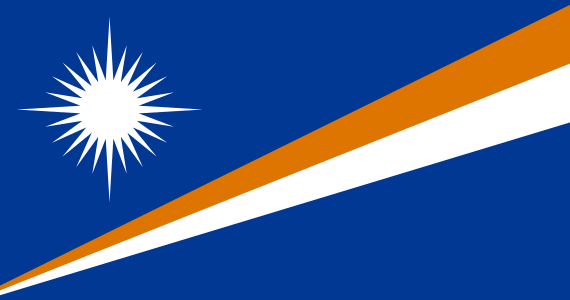
Marshallese
Spoken in the Marshall Islands
Marshallese looks like a foreign puzzle at first — dots under letters, bars over letters, and sounds English has never heard of — but there's a logic to it. The language of the Marshall Islands, one of the world's most remote Pacific archipelagos, is more approachable than it appears. Once you understand the pattern behind those special characters, you'll be reading Marshallese text and producing its unique sounds. Let me show you a language that encodes an entire Pacific culture into its consonants and vowels.
The Secret: Marshallese Is Precise About Sound
Marshallese is an Austronesian language — a distant cousin of Hawaiian, Tagalog, Malay, and Māori. Spoken by roughly 44,000 people on the Marshall Islands (and in diaspora communities across the US, especially Arkansas and Hawaii), it's the co-official language alongside English. What makes it distinctive is a system of retroflex consonants — sounds made with the tongue curled back — that give Marshallese its unmistakable texture.
The good news: spelling is mostly predictable. Once you know what those special characters mean, you can sound out words consistently.
Your Journey: Special Characters, Vowels, Consonants, and Phrases
We'll cover the Marshallese alphabet and its unique characters, how vowels work, the retroflex consonants (the defining feature), basic phrases, and a grammar overview. By the end, you'll understand why Marshallese sounds like nothing else in the Pacific.
Part 1: The Alphabet and Special Characters
Marshallese uses the Latin alphabet with special modifications. These aren't decorations — they mark real pronunciation differences:
| Character | Name | What It Means |
|---|---|---|
| ā | A with macron | Long 'a' — held longer than plain A |
| ō | O with macron | Long 'o' — held longer than plain O |
| ū | U with macron | Long 'u' — held longer than plain U |
| ļ | L with cedilla | Retroflex L — tongue curls back when making this sound |
| m̧ | M with cedilla | Retroflex M — heavier, made farther back in the mouth |
| ñ | N with tilde | Palatal nasal — like 'ny' in "canyon" |
| n̄ | N with macron | Velar nasal — like 'ng' in "singing" |
The most important rule: when you see a cedilla (the small hook beneath a letter), the sound is retroflex — produced with the tongue curled backward. This is the defining feature of Marshallese and what makes it sound distinctly unlike anything in English.
Part 2: The Vowels
Marshallese has a rich vowel system. The basic vowels sound familiar; the modified ones take practice:
Basic Vowels:
| Letter | Sound | English Comparison | Example |
|---|---|---|---|
| A | "ah" | Like 'a' in "father" | an = "ahn" (his/her) |
| E | "eh" | Like 'e' in "bed" | etal = "EH-tahl" (to go) |
| I | "ee" | Like 'ee' in "see" | ij = "eej" (I am / tense marker) |
| O | "oh" | Like 'o' in "go" | okto = "OHK-toh" (eight) |
| U | "oo" | Like 'oo' in "food" | utiej = "oo-TEE-ej" (to rise) |
Long Vowels:
| Letter | Sound | How It Differs |
|---|---|---|
| Ā | Longer "ah" | Same as A but held roughly twice as long |
| Ō | Longer "oh" | Same as O but extended |
| Ū | Longer "oo" | Same as U but extended |
Vowel length changes meaning. Just like Japanese, a short and long vowel produce completely different words. Pay attention to the macrons.
Part 3: The Consonants — Plain Series
Most Marshallese consonants will feel familiar to English speakers:
| Letter | Sound | Example |
|---|---|---|
| B | Like English 'b' | bōb = "bohb" (pandanus fruit) |
| D | Like English 'd' | dān = "DAHN" (water) |
| J | Like 'j' in "jam" | jema = "JEH-mah" (father) |
| K | Like English 'k' | kwe = "kway" (you) |
| L | Like English 'l' | lal = "lahl" (below, downward) |
| M | Like English 'm' | majel = "MAH-jel" (Marshall Islands) |
| N | Like English 'n' | naan = "nahn" (word, speech) |
| P | Like English 'p' | pein = "payn" (hand) |
| R | Slightly trilled | ri = "ree" (person — prefix) |
| T | Like English 't' | tata = "TAH-tah" (very, most) |
| W | Like English 'w' | wōt = "woht" (rain) |
Part 4: The Retroflex Consonants — The Unique Feature
This is where Marshallese gets distinctive. Retroflex sounds are produced with the tongue tip curled backward toward the roof of the mouth. English has no retroflex consonants, so these take real practice.
| Character | Sound | How to Make It | Example |
|---|---|---|---|
| Ļ | Retroflex L | Curl tongue back, then make an L sound from that position | Majeļ = "MAH-jel" (Marshall Islands — formal spelling) |
| M̧ | Retroflex M | Close lips for M, but tongue is curled back — creates a heavier sound | m̧ōk = "mohk" (tired, weary) |
| Ñ | Palatal N | Like 'ny' in "canyon" — tongue presses behind upper teeth | ñe = "nyeh" (if, when) |
| N̄ | Velar nasal | Like 'ng' in "singing" — made at the back of the throat | n̄a = "ngah" (fish) |
How to practice retroflex sounds:
- Make your normal L sound — notice where your tongue tip touches
- Slide the tongue tip slightly backward and upward toward the palate
- Make the L sound from that pulled-back position
- That's the retroflex ļ
The retroflex M (m̧) is rare in world languages. Say "m" but pull your tongue back as you close your lips — it gives the M a darker, heavier resonance.
Critical point: retroflex consonants change word meaning entirely. lal (below) and ļaļ (sun) are different words. Precision matters.
Part 5: Stress and Rhythm
General Stress Rules:
-
Stress typically falls on the final syllable in most words
- iọkwe → ee-yok-WAY (hello/love)
- kommool → kohm-MOHL (thank you)
-
Rhythm is syllable-timed — each syllable gets roughly equal duration, giving Marshallese its flowing, even quality
-
Reduplication doubles syllables for grammatical effects — common throughout Micronesian and Polynesian languages
- A root word repeated or partially doubled signals continuous action or intensity
Part 6: Essential Words and Phrases
Core Greetings:
| Marshallese | Pronunciation | Meaning |
|---|---|---|
| Iọkwe | ee-YOK-way | Hello / Love / Greetings |
| Iọkwe eok | ee-YOK-way ee-YOK | Hello to you (intimate) |
| Kommool | kohm-MOHL | Thank you |
| Kommool tata | kohm-MOHL TAH-tah | Thank you very much |
| Ej eṃṃan | ej em-MAHN | It's good / I'm fine |
| Jouj | jooj | Please / Kindness |
Basic Responses:
| Marshallese | Pronunciation | Meaning |
|---|---|---|
| Aet | ah-ET | Yes |
| Jab | jahb | No |
| Ij maroñ | eej mah-RONG | I can |
| Ijab maroñ | ee-JAHB mah-RONG | I cannot |
| Inaaj | ee-NAH-aj | I will |
People and Place:
| Marshallese | Pronunciation | Meaning |
|---|---|---|
| Ri-Majel | ree-MAH-jel | A Marshallese person |
| Kajin Majel | kah-JEEN MAH-jel | Marshallese language |
| Jema | JEH-mah | Father |
| Jinen | JEE-nen | Mother |
| Laddik | LAH-deek | Boy |
| Kōrā | KOH-rah | Woman / Girl |
Numbers:
| Number | Marshallese | Pronunciation |
|---|---|---|
| 1 | juon | joo-ON |
| 2 | ruo | roo-OH |
| 3 | jilu | JEE-loo |
| 4 | emān | eh-MAHN |
| 5 | lalem | LAH-lem |
| 6 | jiljino | jeel-JEE-noh |
| 7 | jimjuon | jeem-joo-ON |
| 8 | rualitōk | roo-ah-lee-TOHK |
| 9 | ratimjuon | rah-teem-joo-ON |
| 10 | joñoul | joh-NOOL |
Part 7: Grammar Basics
Marshallese grammar differs significantly from English:
Tense-Aspect-Subject Markers:
Marshallese fuses subject pronouns with tense/aspect into single markers placed before the verb:
| Marker | Person + Tense | Meaning |
|---|---|---|
| Ij | I (present/ongoing) | I am [doing] |
| Inaaj | I (future) | I will |
| Iaar | I (past) | I did |
| Kwōj | You (present) | You are [doing] |
| Ej | He/She/It (present) | He/she is [doing] |
| Rōj | They (present) | They are [doing] |
| Kōmij | We — exclusive (present) | We are [not including you] |
| Kij | We — inclusive (present) | We are [including you] |
Example sentences:
- Ij kōnono = "I am speaking" (kōnono = to speak)
- Inaaj etal = "I will go" (etal = to go)
- Iaar loe = "I saw" (loe = to see)
- Kwōj maroñ ke? = "Can you?" (maroñ = able to, ke = question marker)
The Inclusive/Exclusive "We" Distinction:
Marshallese (like many Pacific languages) distinguishes between:
- Kōm = we, NOT including the person being spoken to
- Kij = we, INCLUDING the person being spoken to
English collapses this into one word; Marshallese keeps them separate.
Directional System:
Marshallese has a built-in directional system reflecting island geography. Instead of abstract left/right, directions are anchored to the ocean and lagoon:
| Marshallese | Meaning |
|---|---|
| ļak | Toward the ocean side |
| rōk | Toward the lagoon side |
| tōl | Downward / seaward |
| lal | Below |
| pād | To stay, to be located |
This geographic orientation is woven into everyday speech — Marshallese speakers navigate by ocean and lagoon, not cardinal directions.
Part 8: Common Mistakes to Avoid
| Wrong | Right | Why |
|---|---|---|
| Treating ļ like plain l | Ļ is retroflex (tongue curls back) | Different sounds, different words |
| Treating m̧ like plain m | M̧ is heavier, farther back | Changes meaning entirely |
| Ignoring vowel length (a vs ā) | Length changes meaning | Just like Japanese long vowels |
| Stressing the first syllable | Stress usually falls at the end | Rhythm will sound unnatural |
| Using left/right for directions | Use ocean/lagoon orientation | How Marshallese people actually think spatially |
| Pronouncing ñ like English N | Ñ = "ny" (palatal) | Sounds like the first N in "canyon" |
Part 9: Cultural Context
Iọkwe isn't just "hello." It means love, warmth, and greeting simultaneously. Visitors are often struck by how this single word carries such weight — it's how Marshallese people answer phones, greet friends, and express affection. Starting any interaction with iọkwe immediately signals respect.
Iroij (Chiefs): Marshallese society has a traditional chiefly system. Formal speech differs from everyday language, and rank shapes how people address each other. This formality is embedded in the language.
Nuclear testing legacy: The US conducted 67 nuclear weapons tests on the Marshall Islands from 1946–1958, including the Castle Bravo hydrogen bomb — the largest US nuclear test ever. Bikini and Rongelap Atolls were evacuated. This history shaped modern Marshallese identity, created an English-influenced diaspora, and gave the language new vocabulary for displacement and radiation. It's impossible to understand contemporary Marshallese culture without this context.
Navigation tradition: Marshallese navigators were among the greatest in the Pacific, using rebbelib and mattang — stick charts made of palm fronds and shells — to map ocean swell patterns between islands. This navigational culture lives on in the directional language system. When Marshallese says "toward the ocean" instead of "east," it echoes centuries of open-ocean wayfinding.
UNESCO status: Marshallese is classified as "vulnerable" by UNESCO. With under 55,000 speakers in a tiny, low-lying archipelago facing rising sea levels, it's one of the world's smaller and more fragile languages. Learning even a few phrases connects you to something rare.
Your Path Forward
You've covered the core of Marshallese. The retroflex consonants — ļ and m̧ — are the real challenge. Give yourself time with them; they don't exist in English.
1. Start with iọkwe Practice until it feels natural: ee-YOK-way. It's your entry point into the culture.
2. Master the retroflex sounds
- ļ: tongue curls back, make L from that position
- m̧: lips close for M, tongue pulled back — heavier resonance
- Drill in isolation before combining into words
3. Learn the vowel lengths
- Listen carefully to native speakers
- Notice where words feel longer
- The macron (ā, ō, ū) is a real pronunciation cue, not decoration
4. Find resources
- Marshallese-English Online Dictionary (MOD) — the authoritative reference
- College of the Marshall Islands language resources
- Search YouTube for Marshall Islands content — you'll hear natural speech
5. Try your first full phrase today:
Kommool tata.
Pronunciation: kohm-MOHL TAH-tah
Meaning: Thank you very much.
One Final Challenge
Try reading this aloud:
Iọkwe. Ij kōnono Kajin Majel.
Break it down:
- Iọkwe = ee-YOK-way (hello / love)
- Ij = eej (I am)
- kōnono = koh-NOH-noh (speaking)
- Kajin = kah-JEEN (speech/language of)
- Majel = MAH-jel (Marshall Islands)
Translation: Hello. I speak Marshallese.
You now have the foundation. Those special characters aren't intimidating anymore — they're a precise map to the sounds of a remarkable Pacific language.
Kommool tata — and welcome to Kajin Majel.
P.S. — One quirk that surprises many learners: Marshallese has a dual pronoun system. There's a separate form for "the two of us" versus "all of us" versus "you and I specifically." English flattens all of this into "we." Marshallese keeps the distinctions alive — a language built for small island communities where who exactly is included in "we" has always mattered.
Enjoyed this article? Share it with someone who'd love it too.